25 Dec
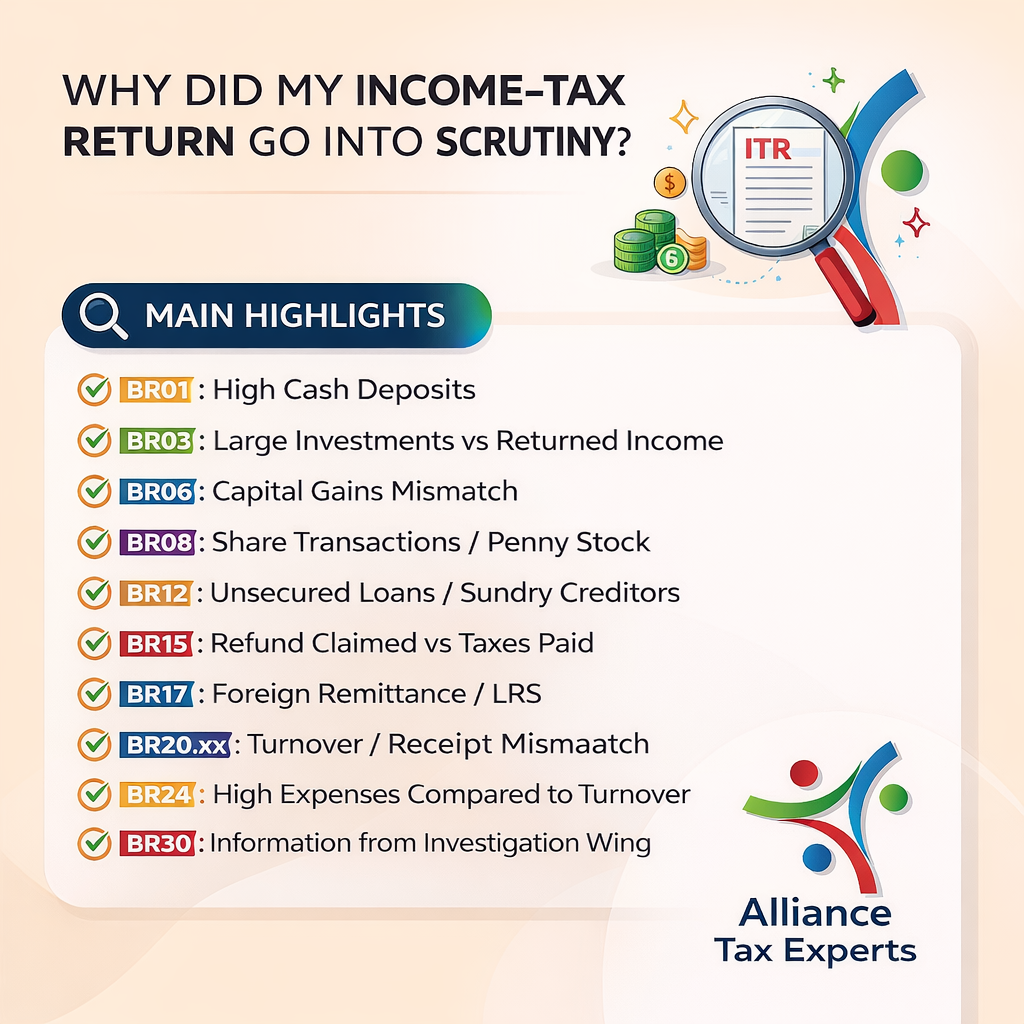
Why Did My Income-Tax Return Go into SCRUTINY?
Why Did My Income-Tax Return Go Into Scrutiny?
A Practical Guide to Scrutiny Reason Codes (CASS /
Faceless Assessment)
Many taxpayers panic when they receive an Income-tax
Scrutiny Notice.
The first reaction is usually fear—“Have I done something wrong?”
The reality is very different.
Scrutiny is not an allegation.
It is only a verification process used by the Income-tax Department to
check certain transactions that appear unusual or inconsistent when compared
with data available to them.
Understanding why your return was selected is the
first and most important step to handling scrutiny successfully.
What Is Income-Tax Scrutiny?
Income-tax scrutiny is conducted under the CASS (Computer
Aided Scrutiny Selection) system and, in most cases, completed under the Faceless
Assessment Scheme.
Returns are selected based on risk parameters, data
analytics, and third-party information such as:
- AIS
/ 26AS
- Bank
transaction reports
- GST
data
- Property
registrations
- Share
market reporting
- Foreign
remittance data
Each scrutiny notice is usually backed by a Business Rule
(BR) Code, which indicates the specific reason for selection.
Although CBDT does not officially publish the full list of
BR codes, certain codes have consistently appeared over the years.
Common Scrutiny Reason Codes and What They Mean
BR01 – High Cash Deposits
This trigger applies when cash deposits in bank accounts
appear disproportionate to the income declared in the return.
Typical situations:
- Cash-intensive
businesses
- Frequent
deposits and withdrawals
- One-time
large cash deposits
Key requirement:
A clear cash flow statement explaining the source and movement of cash.
BR03 – Large Investments vs Returned Income
When a taxpayer purchases property, shares, or other
high-value assets, but the declared income does not seem sufficient to support
such investments.
Common examples:
- Property
purchase
- Heavy
stock market investments
- High
insurance premiums
Key requirement:
A proper source-of-funds explanation—loans, capital buildup, past
savings, or family funds.
BR06 – Capital Gains Mismatch
Mismatch between:
- Sale
consideration in ITR
- Stamp
duty value
- AIS
/ broker data
This is extremely common in property and share sale cases.
Key requirement:
Sale deed, computation working, and correct application of Sections 50C, 54,
54F, where applicable.
BR08 – Share Transactions / Penny Stock
Cases involving:
- High-risk
stocks
- Penny
stocks
- Unusual
trading patterns
These are flagged due to historical misuse of certain stocks
for accommodation entries.
Key requirement:
Complete demat statements, broker contract notes, holding period proof,
and transaction genuineness.
BR12 – Unsecured Loans / Sundry Creditors
Loans or creditors shown in the balance sheet that appear
suspicious due to lack of financial strength or documentation.
Key requirement:
Passing the ICG Test:
- Identity
- Creditworthiness
- Genuineness
PAN, ITR copies, and bank statements of the lender are
essential.
BR15 – Refund Claimed vs Taxes Paid
When a large refund is claimed or tax credits do not match
26AS/AIS data.
Common reasons:
- Incorrect
TDS credit
- Timing
differences
- Data
reporting delays
Key requirement:
Proper 26AS–AIS reconciliation with documentary proof.
BR17 – Foreign Remittance / LRS
Foreign transactions or remittances flagged under the Liberalised
Remittance Scheme (LRS).
Key requirement:
Purpose of remittance, source of funds, and FEMA compliance explanation.
BR20.xx – Turnover / Receipt Mismatch
One of the most common scrutiny reasons today.
Mismatch between:
- ITR
turnover
- AIS
/ 26AS
- GST
returns
- Bank
credits
Key requirement:
A 3-way reconciliation and identification of non-income receipts such as
reimbursements, loans, or internal transfers.
BR24 – High Expenses Compared to Turnover
When profit margins appear unusually low or expenses seem
excessive.
Key requirement:
Expense break-up, business justification, and past-year comparison to establish
commercial reality.
BR30 – Information from Investigation Wing
Cases selected based on third-party intelligence, surveys,
or search-related inputs.
Key requirement:
Demanding complete material relied upon and responding strictly based on
evidence and principles of natural justice.
How Faceless Scrutiny Is Decided
In faceless assessment, personal explanations carry no
weight.
Decisions are based entirely on:
- Reconciliation
- Supporting
documentation
- Legal
clarity and factual presentation
Poorly drafted replies or incomplete documents often lead to
unnecessary additions—even when the case is genuine.
Key Takeaways for Taxpayers
- Scrutiny
does not mean tax evasion
- Most
cases are resolved when facts are explained properly
- Early
and structured replies significantly reduce litigation risk
- Documentation
matters more than arguments
Professional Insight
In my experience, 90% of scrutiny additions fail
when:
- Transactions
are genuine
- Books
are maintained properly
- Replies
are legally structured and evidence-based
Faceless scrutiny is a technical process—not an emotional
one.
Need Help With a Scrutiny Notice?
If you’ve received a scrutiny notice and are unsure how to
respond, professional guidance at the right stage can save time, money, and
stress.
Santosh Patil
Founder – Alliance Tax Experts Pvt Ltd
Tax | Scrutiny | Faceless Assessment | Litigation Support
#IncomeTaxScrutiny #FacelessAssessment #CASS #AIS #DirectTax #TaxLitigation #IncomeTaxNotice #CharteredAccountant #AllianceTaxExperts